
Why Silicon Valley's "Good AI" Is Built on a Bad Assumption
Silicon Valley codes moral universals into its AI and calls the ethical work done, but Kierkegaard warned that the crowd's morality can never replace the individual's responsibility.
18 August 2025 · 6 min read
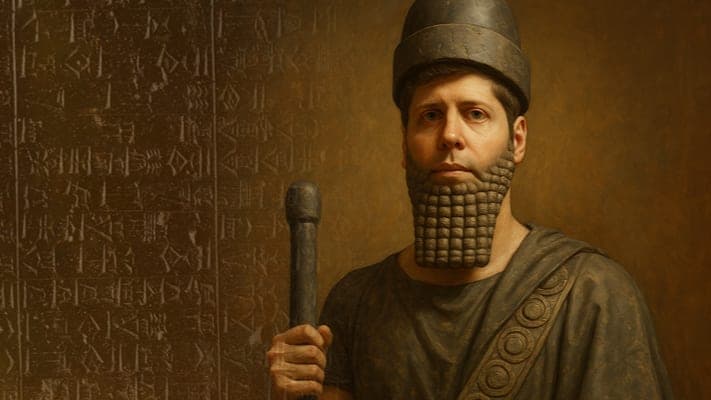
When tech giants talk about ethical AI, they usually mean something like harm reduction, fairness, or accountability.
Sounds universal, right?
Something so obvious you'd be a fool (or a villain) to disagree?
Not so fast.
Beneath the glossy decks and "responsible innovation" frameworks lies a philosophical sleight of hand. These aren't actually conversations about ethics in the Kierkegaardian sense: they're about morality, and there's a difference big enough to drive an autonomous truck through.
Kierkegaard's missing warning
For Søren Kierkegaard, ethics is personal. It's about the individual standing before God, or, in secular terms, before their own deepest responsibility, making choices they cannot outsource (Kierkegaard, Fear and Trembling, 1843).
Morality, in contrast, is social. It's the codified norms, rules, and expectations that govern collective life. Morality is the crowd's consensus on what's right; ethics is the single individual's wrestling with what's right for them, here, now, in this concrete situation (Lippitt, 2003).
Kierkegaard warned that morality, while necessary for social order, can smother ethics. It tempts us to hide in the safety of the universal rule and avoid the anguish of personal responsibility. Or, as he put it bluntly:
The crowd is untruth.
Søren Kierkegaard, The Point of View for My Work as an Author
From the crowd to the cloud
Fast-forward 180 years, and Silicon Valley has industrialised the crowd's morality into code. AI "ethics" teams draft principle sets that look like moral universals: Do no harm. Ensure fairness. Be accountable.
These are important aspirations, but they are morality in Kierkegaard's sense: rules framed to apply to everyone, everywhere.
They are not ethics in his sense: the lived, individual confrontation with the demands of responsibility. In fact, they risk doing the opposite: relieving individuals, whether engineers, executives, or end-users, of the burden of thinking, by embedding the rules into the system itself (Mittelstadt, 2019).
The machine becomes the crowd.
The seduction of universal principles
Part of the appeal is that moral universals feel safe. They promise order in a messy world. If we can just agree on a few high-level values, the thinking goes, we can avoid chaos and prevent the worst abuses (Floridi et al., 2018).
From this angle, Kierkegaard's insistence on personal, situational responsibility can look like a recipe for ethical anarchy. Surely it's better to have pre-agreed rules, i.e. harm reduction, fairness, transparency, than to leave everything to individual conscience?
The counter-argument has real force, especially when you imagine AI operating across borders and at scale. Without shared baselines, bad actors could exploit the gaps (Jobin et al., 2019). Think of aviation safety: planes fly more safely because there's a global consensus on minimum standards.
Why Kierkegaard would still worry
The trouble is that moral universals, once codified, easily become moral absolutes. And absolutes tend to mask the perspective they come from.
In today's AI landscape, that perspective is overwhelmingly shaped by U.S.-based, corporate tech culture (Mohamed et al., 2020). These companies are the ones defining what "harm" means in practice, what metrics "fairness" will use, and what counts as "accountability." Once embedded in AI systems, those definitions travel the globe, detached from the culture that birthed them, but still carrying its imprint.
For Kierkegaard, the ethical life begins when you step away from the crowd, even a benevolent, well-intentioned one, and face yourself as what he calls "the single individual." It is in this solitude that responsibility becomes real. As he insists in Either/Or:
He must himself give the explanation of his life, and not in relation to another but in relation to himself. He must himself take upon himself the responsibility for his life.
Søren Kierkegaard, Either/Or, Vol. II
The ethical mode demands this inward appropriation: Am I responsible for this decision, here and now, before my own conscience? By contrast, the merely moral mode offers an escape from that burden. It allows you to hide in the impersonal, in what Kierkegaard elsewhere calls "the crowd," which "renders the individual completely impenitent and irresponsible." In morality, the decision is no longer yours in the deepest sense; it belongs to the code, the rulebook, the anonymous "what everyone does."
AI's moral universalism risks building that abdication into the very fabric of our decision-making tools.
Morality flattens, ethics deepens
To see how this flattening works, look at fairness in machine learning. Morality says: "Treat similar cases the same." This becomes a statistical parity formula (Barocas et al., 2019). It's clean, measurable, and universal, exactly the kind of thing you can bake into a model.
Ethics, in Kierkegaard's sense, might demand more: to see the unique human in front of you, to consider context, history, relationships, and consequences beyond the dataset. That kind of responsibility doesn't compress well into an API. As he puts it:
When the ethical as such is posited, then the single individual is put in immediate relation to the universal, and his task is himself, but himself in his eternal validity.
Søren Kierkegaard, Either/Or, II
Which is why moral universals are so attractive to engineers and policymakers alike: they're easier to implement and defend. But in making them easy, we risk losing the depth that ethics demands.
The counterpoint: we can't all be Kierkegaard
The obvious objection is that we can't run global AI systems on the assumption that every engineer or policymaker will live in a state of existential ethical readiness. The stakes are too high, the systems too complex, the speed too fast.
From this view, morality is not the enemy; it's the only workable foundation. Without codified, universal rules, every AI-driven decision would be a wild card. Ethical subjectivity might be fine for personal relationships, but it's no way to run a power grid, an air-traffic control system, or a medical triage algorithm.
And there's truth in that. Kierkegaard's radical individualism is hard to scale.
But here's the move Kierkegaard would insist on: you can have universals without surrendering ethics. Shared values can guide AI, if they remain open to challenge, reinterpretation, and context-sensitive application. That means building systems that don't just apply rules, but make room for human responsibility at every level: design, deployment, and use.
It also means resisting the temptation to treat moral universals as settled truths. In Kierkegaard's terms, we must hold them "in fear and trembling," aware that even our most noble principles can harden into unexamined dogma.
Re-introducing the individual
What would that look like in practice?
In design. AI teams trained not just in compliance, but in moral philosophy, so they can see when a principle needs situational interpretation.
In governance. Oversight structures that include dissenting voices and cultural perspectives outside the corporate bubble (Mohamed et al. 2020).
In use. Interfaces that don't just spit out answers, but explain the reasoning, limitations, and uncertainties, inviting the human in the loop to make an informed choice.
This is ethics in the Kierkegaardian sense: systems that refuse to let individuals hide in "the crowd" of the machine.
The conclusion: from crowd to conscience
Silicon Valley's "good AI" runs on the bad assumption that morality and ethics are the same thing: that once you've coded the moral universals into the system, the ethical work is done. Kierkegaard knew better. Morality can guide us, but it cannot replace the individual's responsibility to wrestle with the right thing in the moment. In the age of AI, that means refusing to let the machine be the crowd we disappear into. It means designing for conscience as well as compliance. The question is not whether we share values, but whether we can keep the individual awake inside them.
Because ethics, unlike morality, cannot be outsourced, not even to the smartest algorithm in the room.
Dr Marco Motta works at the intersection of philosophy, data analytics, and AI. He helps organisations understand not just what their data says, but how it should be interpreted and acted on. Drawing on a background in phenomenology and years of experience in analytics consulting, he brings a critical, human-centred perspective to the design and governance of data and AI systems.
A version of this article was first published by Dr Marco Motta on LinkedIn.
Want to talk it through?