
A New Priestly Class: Nietzsche, Morality, and Silicon Valley
Following the Kierkegaard critique, this second essay turns to Nietzsche's genealogy of morals to ask whether Silicon Valley's AI labs have become a self-authorising priestly class.
25 August 2025 · 8 min read
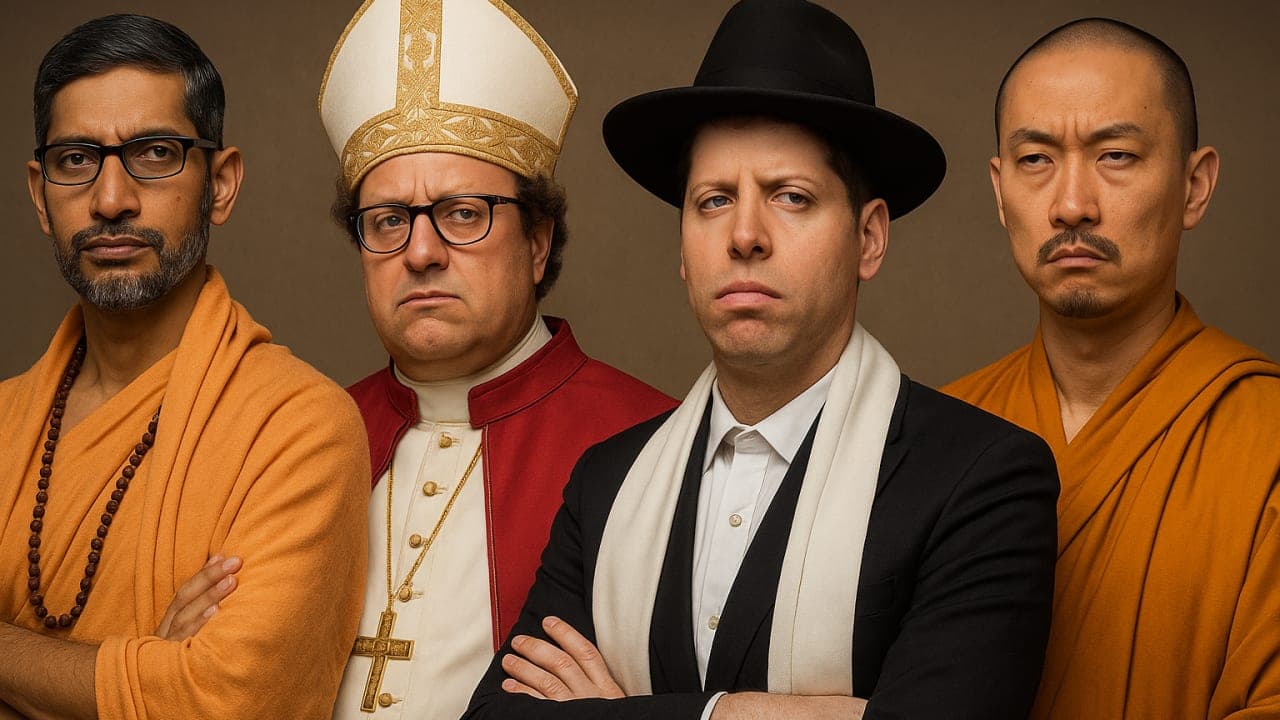
In the first article of this series, I argued, following Kierkegaard, that much of Silicon Valley's so-called AI ethics is not ethics at all, but morality in the narrow sense: a codified, heteronomous system built for compliance rather than inward transformation. Kierkegaard warned that such morality is "dead" because it doesn't demand personal appropriation.
But Kierkegaard doesn't go far enough. He tells us what an ethical life requires but not how a moral system emerges, or whose interests it serves. For that, we turn to Friedrich Nietzsche.
From inward task to historical genealogy
Where Kierkegaard challenges us to step away from "the crowd" and claim responsibility, Nietzsche's On the Genealogy of Morals (1887) digs into the origins of moral orders themselves. His unsettling answer: much of what we call morality is the historical creation of a priestly class, a group that claims moral superiority and uses codes to bind, direct, and control others.
Nietzsche's genealogy begins with the famous distinction between master morality and slave morality. In master morality, good describes the qualities of the strong, self-determining individual; bad simply refers to what is weak or ignoble. Slave morality, born of the ressentiment of the powerless, reverses the terms: the strong become "evil," the meek "good."
The priestly class is the great architect of this inversion. Lacking direct force, the priest works through moral revaluation, that is, redefining virtue, sin, and redemption in ways that grant them interpretive monopoly. As Nietzsche puts it:
The priest transforms the power of the strong into a guilt before God; in doing so, he becomes master in the very realm in which the strong had no power: the realm of conscience.
Friedrich Nietzsche, On the Genealogy of Morals
It's domination by definition-making. Power becomes moral obligation.
Silicon Valley's moral vocabulary
The analogy to AI governance is not hard to see. Read the public-facing statements of the leading AI labs:
OpenAI. pledges to ensure artificial general intelligence "benefits all of humanity."
Anthropic. talks about aligning systems with "human values."
DeepMind. promises to be "socially beneficial" and "avoid creating or reinforcing unfair bias."
All laudable on the surface. But as Nietzsche would insist, these are perspectival rather than neutral claims. They present a specific evaluative framework (Western, liberal-democratic, technocratic) as if it were the universal moral law. And in doing so, they legitimate the authority of those who speak in its name.
The doctrine of reluctant stewardship
Nowhere is this priestly parallel sharper than in what might be called Silicon Valley's doctrine of reluctant stewardship. The script goes like this:
AI leaders acknowledge the immense risks of their technology.
They urge regulation to mitigate these risks.
They also insist they must play a central role in designing that regulation.
Sam Altman told the U.S. Senate in May 2023:
If this technology goes wrong, it can go quite wrong… regulatory intervention by governments will be critical to mitigate the risks.
Sam Altman, U.S. Senate, May 2023
Demis Hassabis of DeepMind told the Financial Times in June 2023 that benefits must be "shared fairly" and risks "mitigated," but emphasised "close collaboration" between policymakers and the companies themselves.
Dario Amodei of Anthropic, at the AI Safety Summit in November 2023, stressed:
AI safety is everyone's responsibility, but those of us building the most capable systems must lead in developing the safeguards.
Dario Amodei, AI Safety Summit, November 2023
This is textbook priestly authority: the law is binding on all, but the right to interpret and apply it is reserved to the priesthood.
Perspectivism vs. universalism
Nietzsche's perspectivism is a direct challenge here:
There are no moral phenomena at all, only moral interpretations of phenomena.
Friedrich Nietzsche, Beyond Good and Evil
When AI leaders speak of "human values" or "benefit for all humanity," they speak from somewhere, that is a particular cultural and economic standpoint. But the presentation is of a "view from nowhere," an unassailable universality.
The reality: value selection in AI systems, i.e. deciding what counts as harm, how to trade off safety against innovation, what risks to prioritise, is always contestable. The danger is not that values exist, but that one narrow set of them becomes the default moral architecture for the globe.
Foucault's power/knowledge twist
Michel Foucault sharpens Nietzsche's insight: power is not merely repressive (the force that says "no") but productive, in that it actively shapes what can be known, said, and even imagined. It doesn't just police behaviour; it constructs the categories through which reality is understood.
In the AI domain, moral principles never travel alone. They are bound up with technical vocabularies, i.e. "alignment," "safety," "risk," "catastrophic misuse", that define the field of action. These are not neutral descriptors. They carry within them the assumptions, priorities, and blind spots of those who coin them.
As Foucault writes:
Power produces; it produces reality; it produces domains of objects and rituals of truth.
Michel Foucault, Discipline and Punish
Which leads to the uncomfortable question: Who defines these terms? Who decides what "alignment" means, what metrics count as evidence of "safety," or which scenarios qualify as "catastrophic misuse"?
If the answer is the same handful of companies building the technology, then moral and epistemic authority have fused into a single point of control. This is not just a priesthood of values; it is a priesthood of truth itself. The risk is that both the moral horizon and the knowledge horizon of AI are being set by an elite whose worldview is presented as universal, and whose categories leave little room for rival moral or technical imaginaries.
The institutional form of priestly power
Look at how governance is structured:
Monopoly on interpretation. Public principles exist, but leadership controls the official meaning.
Control of access. Deliberations on ethics and safety happen behind closed doors.
Moralisation of dissent. Critics can be painted as irresponsible or dangerous.
OpenAI's Preparedness Framework monitors for "catastrophic misuse", but the monitoring body is internal. DeepMind's ethics board operates under NDAs. Anthropic's "constitutional AI" approach publishes its rulebook but keeps the power to amend it in-house.
Counterarguments: Not a monolith
Some will object: Silicon Valley is far from a unified priesthood. Internal dissent exists. The firing of Timnit Gebru and Margaret Mitchell from Google's Ethical AI team in 2020-21, after they published research on racial and gender bias in large language models, sparked open protest from employees and academics.
Others, including researchers at Anthropic and DeepMind, have explicitly acknowledged the danger of imposing a single, monolithic moral framework on AI systems, instead calling for value pluralism in alignment design. DeepMind, for example, has an internal research stream called "Voices of All in Alignment", which "focuses on alignment techniques for value and viewpoint pluralism" (DeepMind Alignment Team Summary, Alignment Forum). This work recognises that aligning AI to a single, supposedly universal set of values risks erasing legitimate cultural and moral diversity.
More fundamentally, Atoosa Kasirzadeh (2024) provides a prescriptive framework distinguishing between first-order value choices (the specific values to embed) and second-order legitimisation choices (who decides those values and how). As she warns:
First, it helps prevent 'pluralistic value-washing' where superficial appeals to insignificant pluralism could mask fundamentally monistic alignment approaches.
Atoosa Kasirzadeh, Plurality of value pluralism and AI value alignment
In practical terms, this means pluralism cannot be a cosmetic cover, an acknowledgement of diversity without structural change. Otherwise, it risks becoming a veneer over what remains a fundamentally monolithic system.
These interventions underline that "value alignment" is never simply a technical problem. Rather, it's an inherently political one. Without deliberate safeguards for pluralism, alignment risks becoming the moral equivalent of monoculture agriculture: efficient, standardised, and profoundly brittle when faced with real-world diversity.
These are real points of resistance. But as Foucault would note, resistance within a regime doesn't dissolve the regime. Dissent can be marginalised or even absorbed as a token of openness without altering the core structure of authority.
Counterarguments: Multipolar AI
Another objection is that U.S. dominance is fading, giving way to a multipolar AI ecosystem. China's Baidu has released ERNIE Bot and DeepSeek, which rival GPT-class models in capability. Europe has Mistral AI, which is pushing high-performance open-weight models such as Mixtral 8x7B. Open-source communities like Hugging Face and LAION are making cutting-edge architectures widely available outside corporate silos. On this view, no single geography or corporate culture can fully dictate the moral and epistemic infrastructure of AI.
Yet the infrastructural influence of U.S.-based firms remains disproportionately high. The APIs (OpenAI, Anthropic, Google), frameworks (PyTorch, TensorFlow), model architectures (transformer-based LLMs), content moderation pipelines, and benchmark datasets (MMLU, HELM, BIG-bench) developed in Silicon Valley and allied Western research institutions set de facto global standards. Even when models are trained in China, they often adopt similar architectures and safety guardrails, for instance, DeepSeek's refusal to answer politically sensitive questions such as those about the 1989 Tiananmen Square protests mirrors OpenAI's and Anthropic's refusal to engage in certain "unsafe" outputs, albeit for different political reasons.
This suggests that multipolarity does not equal pluralism. What we see emerging are competing closed frameworks, each shaped by its own political and cultural constraints, but all operating on shared technical blueprints and moral architectures inherited from, or at least heavily influenced by, Silicon Valley. As in global finance or internet governance, the underlying standards-setting power remains concentrated, even if the visible players appear more geographically diverse.
Why this matters
Nietzsche's genealogy shows what Kierkegaard's crowd critique left implicit: Silicon Valley's moral order is the creation of a self-authorising elite, secured by framing its own standpoint as universal. This isn't just defensiveness. It's what Nietzsche called the will to power, the drive not just to preserve one's position, but to shape the moral and epistemic world itself.
Once established, such a role is not easily surrendered. Like Schopenhauer's "will to live," it expands, resists limitation, and presents itself as necessary for the good of all. This is something we will explore in the next article in this series.
However, this is not a call to swap one fixed moral code for another. It's a call to keep ethics alive: contested, open, and unwilling to cede moral and epistemic authority to any single class, however well-intentioned.
If AI ethics becomes just another priestly project, then the question won't be whether the rules are good or bad. It will be whether we are willing to live in a moral world whose terms have already been written for us.
Dr Marco Motta works at the intersection of philosophy, data analytics, and AI, helping organisations understand not just what their data says, but how it should be interpreted and acted on.
A version of this article was first published by Dr Marco Motta on LinkedIn.
Want to talk it through?